Since 2016, Cognitive World has been focused on the practical value of enterprise AI solutions.
Learn more about our purpose and our think tank.
COGNITIVE WORLD on FORBES features over a thousand editorial articles by our think tank and contributor members, and our COGNITIVE WORLD think tank on VentureBeat features more.
As I stated in my piece last February, there aren’t a lot of sure-fire methods to slow down the development of AI. But there are some potential levers that could help. The most commonly discussed are legal and regulatory approaches.
Treat explainability as infrastructure. Ask vendors about their substrate, not their dashboard. Hire the librarians. Give the project a year. The AI deployment that wins the next decade is the one whose conclusions you can defend in a deposition. That deployment is not the one with the best reasoning-display screen. It is the one whose foundations were built to hold the trail, and whose builders were given the time to lay them.
Smaller banks are often told they are behind on enterprise AI. That is true, but only up to a point. In practice, many of them already run on a more standardized operating base than the largest banks, because so much of their work moves through SaaS and core banking platforms that quietly shape how the bank operates.
AI investment is accelerating, yet business outcomes remain elusive. The root cause is fragmentation — siloed automation tools disconnected from AI strategy. This paper presents a stage-by-stage roadmap for enterprise leaders to unify AI and IT automation investments, achieve measurable ROI within 9–12 months, and build the architecture required for agentic, enterprise-scale automation.
The next decade will see AI evolve beyond isolated applications into dynamic intelligence fabrics, exhibiting contextual awareness, cooperative reasoning, and continuous learning across all sectors. Future AI will possess persistent memory, multimodal perception, and long-term planning, creating vast digital workforces that blur the line between software and human employees.
I have co-authored several articles over the last year or two that together suggest organizations are not likely to get business value with genAI if their primary focus is improving individual productivity. But everybody doesn’t read Harvard Business Review, and I have never put all the reasons for this in one place. So here goes—a laundry list of explanations for why you’re probably not going to achieve measurable productivity gains from genAI.
IBM CEO Arvind Krishna recently made a point in the Wall Street Journal that is worth taking seriously. “AI is not helping your business. It is your business model.” He’s right, because most conversations about AI are still happening at one level below what he’s describing.
The AI dashboard shows you the exact cost of a chatbot interaction, but not the business value of that interaction. That gap is about to become more than a budget problem. It is becoming a competitiveness problem, and most businesses have no pipeline in place to close it.
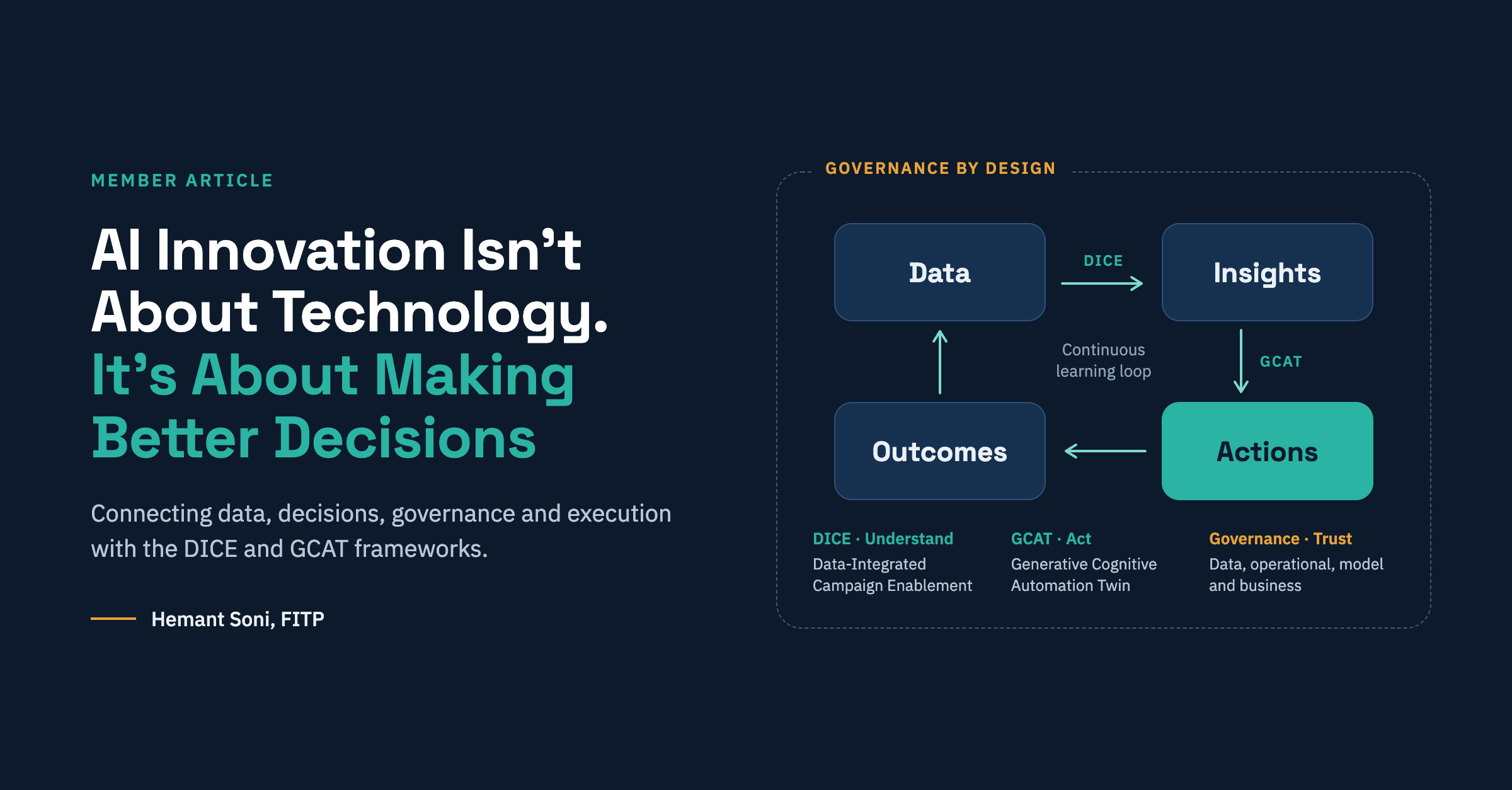
Much of the effort and attention around AI for the last several years has been around technical developments. New model announced! New benchmark surpassed! New contract for massive data centers! New world-class technologists hired! You know the drill.
I am happy to say, however, that things are beginning to change in this regard. AI companies are beginning to realize something that many corporate executives knew intuitively. What matters isn’t the technology—OK, that’s important too—but the ability of organizations to deploy it effectively and get value from it.
The irony is hard to miss. SR 26-2 leaves each bank to determine how agentic AI should be governed through its own risk framework and architecture. Inside the workflow, the agent is doing its own version of that: resolving what its inputs mean before it acts. hat is where the hardest problem now sits: not in the model output or the execution record, but in the reasoning layer, where operational meaning forms before action.
Few companies deliberately integrate process management and knowledge management practices when deploying AI. Process management (PM) and knowledge management (KM) typically reside in separate silos where process often sits in operations with an emphasis on Lean Six Sigma and knowledge management often rests in HR. Meanwhile, AI initiatives are regularly led by data/IT teams. Major opportunities are missed as these three initiatives are rarely integrated.

Most organizations today use artificial intelligence (AI) primarily for isolated productivity tasks. Employees ask models to summarize reports, draft emails, generate presentations, analyze spreadsheets, or answer questions. These applications create measurable gains, but they often automate only fragments of a larger operational process.
AI is beginning to transform IT operations in significant ways and impacting the bottom line. This article will discuss how IT operations can be transformed by embedding AI into IT Operations. Key use cases impacted by AI across IT operations such as infrastructure & application deployment, management of deployed environment and remediation of issues will be discussed. An example will then be provided so that reader has a better understanding on how to transform IT Operations with AI.


The allure of AI in supply chain management is real. Executives envision chatbots that instantly answer questions about shipment status and delivery exceptions, and knowledge graphs that surface hidden relationships between suppliers, routes, and delivery outcomes. In last-mile logistics where conditions shift by the minute these are not fantasies, they are the future of supply chain intelligence.
In March 2023, the failure of Silicon Valley Bank exposed what practitioners had long understood: operational risk governance failures at individual institutions can cascade into systemic crises. The Federal Reserve’s post-mortem found that SVB had 31 unaddressed supervisory warnings at the time of its failure — triple the average of its peer institutions. The root causes were not exotic. They were failures of basic risk identification, control documentation, and management oversight.
Over the past ten years, every executive who has sanctioned a cybersecurity budget can detail the vendor risk process. A SaaS contract triggers a SOC 2 review, sub-processor reviews, data handling reviews, breach notification clauses, etc. NIST and ISO 27001 codify it. It is a developed field.
There is increasing consensus that to get value from AI, you have to redesign your business processes and embed AI within them. A McKinsey 2025 survey, for example, found that redesigning workflows is the factor most highly correlated with getting value from AI. A 2026 paper from MIT researchers argues that AI benefits will come from supporting “chains” of business activities, i.e. processes. My friend Erik Brynolfsson, head of Stanford’s Digital Economy Lab, has long argued that in a “J curve” situation, productivity with AI initially lags as companies re-engineer processes, but then increases significantly once AI is fully integrated into new, redesigned workflows.
Artificial intelligence (AI) has created a paradigm shift for Cybersecurity. AI and machine learning (ML)-powered computing systems are now essential to cyber operations. They assist security teams in keeping an eye on large networks, spotting irregularities instantly, and reacting more quickly than is humanly feasible. By automating tasks that would otherwise overburden under-resourced teams, AI levels the playing field in today's threat landscape, which is characterized by sophisticated ransomware, social engineering, and malware.
AI has brought significant advances in automation, decision-making, and content generation, but these benefits carry inherent risks that demand robust security measures. AI security spans data privacy, model integrity, adversarial robustness, and regulatory compliance. This article examines the primary threat vectors targeting AI systems, the key domains requiring protection, and the security controls organizations should put in place to address them
The primary drivers behind BPO decisions haven't changed dramatically: cost reduction, access to specialized talent, scalability, and the ability to focus internal teams on core business. What has changed is how AI reshapes the calculus on each of these.
Every time your organization deploys an AI system, a critical decision gets made — usually by a developer, sometimes by a vendor, rarely by anyone with accountability for the outcome. That decision is: what kind of AI are we using? And in most enterprises today, the honest answer is: we don't actually know, and we don't have the language to find out.
It's good work. Five forces - technology, economics, geopolitics, demographics, climate - each with their own core shifts and key uncertainties.
The work isn’t prediction. It’s perseverance. It’s staying with the complexity long enough to recognize patterns instead of imposing them. It’s building systems that make it easier for the parent with the 13-point cognitive tax to access the same quality of care, information, and decision-support as the investor reading Amy Webb’s report at $10,000 a seat.
That’s not a technology problem. It’s not even an AI problem. It’s a recognition problem — who we see, what we count, and whether we’re willing to build for the ground conditions that already exist instead of the convergence we hope is coming.
But generative AI is clearly changing the process of data analysis. I’ve been experimenting with quantitative data analysis using ChatGPT for several years now. I was certainly impressed by the LLM’s ability to generate Python code to analyze structured data and create machine learning models.
I’m reading Jill Lepore’s book If/Then about the origins of analyzing human behavior data with computers. One interesting aspect of it is the automation paranoia arising from the introduction of the IBM 704 mainframe computer in 1954 (the year I was born). The book even includes an image from an automation-focused campaign leaflet for John F. Kennedy’s 1960 presidential campaign—see it above.
As the common logic goes, a smooth road can make you sleepy. A bumpy road keeps you alert. Organizations are increasingly deploying AI to automate discrete activities and sub-processes. Examples are AI copilots that draft, summarize, and decide, and increasingly, AI agents that execute multi-step work with minimal human input. The cumulative logic is irresistible: less friction at each step means faster throughput and higher productivity for all.
Artificial intelligence is changing cybersecurity faster than most companies expected. It is helping security teams catch threats earlier, sort through overwhelming volumes of alerts and respond more quickly. But it is also making life easier for attackers, who can now produce more convincing phishing emails, better impersonation scams and more targeted attacks at much greater scale. This is what makes the current moment so important. AI is not just improving cybersecurity tools. It is changing the nature of the fight itself.
Quantum computing stands at an intriguing but early stage of development. The technology is advancing, and there are credible signs of progress across hardware, algorithms, and ecosystem readiness. However, the leap from controlled pilots to mainstream enterprise adoption remains substantial. For now, quantum computing is best understood not as an immediate disruptor, but as a strategic, long-term investment—one that organizations should monitor closely, experiment with cautiously, and prepare for thoughtfully.
After years of anticipation, quantum computing is no longer a distant promise. It has moved decisively into the center of the technology conversation, joining artificial intelligence as one of the defining breakthroughs of recent years. The shift has been driven by an acceleration in scientific progress and a surge in corporate investment that has pushed quantum computing from a laboratory experiment to a strategic priority.
Pricing is one of the most important decisions for organizations and individuals. We may pay 20 dollars for a glass of wine in a restaurant while the same bottle costs the same at a grocery store. The liquid is identical. The value is not. We are paying for context, service, timing, and experience. Price is not a static number. It is a quantified expression of perceived value at a particular place and time.
Digital infrastructure serves as the foundation for national security, the economy, and everyday life in today’s hyper-connected world. Artificial intelligence (AI) and quantum computing are examples of emerging technologies that inspire creativity. However, these technologies also magnify risks posed by sophisticated attacks, black swans, gray swans, economic volatility, and geopolitical tensions. At this point, resilience—the ability to anticipate, endure, and recover from disruptions—is absolutely necessary.
KEY ALLIANCES
Collaboration will connect subject matter experts, co-create content, and accelerate the delivery of insights to a global audience. HOUSTON, TX — April 13, 2026 — APQC, the benchmarking and best practices research organization, and Cognitive World, a global thought leadership platform focused on AI and digital transformation, today announced a strategic collaboration to share expertise, co-develop content, and expand the reach of insights across their respective communities.
We’re excited to announce a new strategic collaborative alliance between ISSIP (International Society of Service Innovation and Professionals) and Cognitive World.
Emerging Lens
Cinema is undergoing a quiet revolution. As artificial intelligence begins to design storyboards, generate lifelike faces, and even script dialogue, filmmakers everywhere are confronting a question that cuts to the heart of creativity: what remains distinctly human in storytelling? The tension between algorithmic precision and emotional imperfection is reshaping how stories are told and how audiences connect with them.
When I interviewed Professor Ben Zhao from the University of Chicago, I didn’t just learn about computers and AI. I learned about kindness, fairness, and standing up for people who are being hurt by technology. Professor Zhao was named in Time Magazine’s AI 100 List in 2024 for his amazing work, but what impressed me most was how much he cares about helping artists.
Member Content
Andrew Spanyi met with Alan Trefler, the founder and CEO of Pegasystems, to discuss the state of AI and how enterprises can gain the most value in applying Gen AI today. They discussed a range of topics including the poor track record of Gen AI pilots, the importance of customer focus in deploying AI, the role of collaboration and Agentic AI, and that the fact is -- technology is not the real problem -- it’s mindset.
Andrew Spanyi met with Jim Sinur about the state of artificial intelligence (AI). Jim shared a couple of AI success stories - one in insurance and another in farming - which was refreshing since we hear so much about challenges with AI. When asked about the outlook for AI on the short to medium term, Jim discussed the likelihood of convergence. Jim Sinur was a former Gartner VP & Distinguished Analyst and is a member of Cognitive World’s Think Tank. His current focus is to help organizations thrive in the digital age. He also entertains people with his art and music.
Andrew Spanyi recently talked with Seth Earley about the state of AI in the enterprise. Seth shared his perspective on some of the challenges with AI and the importance of data in particular. He discussed the size of the gap between hype and actual performance in deploying AI, and the extent to which large language models (LLMs) may pose a threat to society in the medium term.
The Health Data Dilemma: As artificial intelligence (AI) reshapes healthcare, ethical and effective health data management emerges as a pivotal challenge. One critical asset will determine the true potential of AI in healthcare: health data. This deeply personal information holds immense power to fuel groundbreaking innovation, drastically improve patient outcomes, and create profound value for individuals, healthcare professionals, and enterprises alike.
The promise of AI Agents is transformative – that's undeniable. But as enterprises race to adopt the Agent buzzword, we can't afford approaches that won't deliver on that promise. Perhaps the most dangerous misconception in enterprise AI today is that agents can simply be defined and managed through prompts alone. This prompt-centric approach creates fundamental challenges to implementing agents that enterprises must consider.
For some time now, enterprise researchers have struggled with diminishing access to executives. Driven by increasing demands on c-suite time and organizational flattening, earlier global sources of leadership surveys have diminished and, in some cases, evaporated entirely.
Human health has witnessed a remarkable transformation. With more to come.Over the years technological advancement that has revolutionized the way we deliver and receive care. From the advent of antibiotics to the development of next generation imaging techniques, tech advancement has played a crucial role in improving patient outcomes and enhancing the overall quality of healthcare services.
We are pleased to announce Think Tank member Chuck Brooks’ new book: Inside Cyber: How AI, 5G, and Quantum Computing Will Transform Privacy and Our Security, 1st Edition. Discover how to navigate the intersection of tech, cybersecurity, and commerce in an era where technological innovation evolves at an exponential rate, Inside Cyber: How AI, 5G, IoT, and Quantum Computing Will Transform Privacy and Our Security…